
- What a multi-agent system is and why single-agent AI often falls short for complex tasks
- The core building blocks of any MAS, from agents and environments to communication protocols
- The main architectural patterns, hierarchical, federated, blackboard, and hybrid, and when to use each
- Key design decisions that determine whether your MAS succeeds or becomes a debugging nightmare
- Real-world applications and a practical starting point for building your first multi-agent system
Single AI models are impressive. But push them hard enough and they crack. Ask one model to manage a supply chain, write content, monitor performance, and talk to customers all at once, and you'll see the limits fast. That's where multi-agent system architecture changes the game.
A multi-agent system (MAS) is a group of independent AI workers, each with a specific job, collaborating to hit a bigger goal. Think of it less like one genius trying to do everything and more like a well-run team where everyone knows their role.
Multi-agent systems are not a future concept. Companies are already running them in supply chains, trading platforms, smart grids, and content operations. The question isn't whether MAS works. It's whether you're ready to build one.
In this guide, we break down how MAS works, the core components you need, the most common architectural patterns, and how to get started without overcomplicating things. Whether you're a developer, a founder, or just AI-curious, this is the practical walkthrough you've been looking for.
Why Multi-Agent Systems Are a Game Changer (and Not Just Hype)
Let's be honest. Large language models are powerful. But they're generalists. They struggle when tasks require real-time adaptation across multiple domains at the same time.
Here's a simple way to think about it.
Imagine you need to manage a smart city. Traffic flow changes by the minute. Waste collection routes shift based on fill levels. Energy demand spikes during a heatwave. Now ask yourself: do you want one giant AI trying to juggle all of that? Or do you want three specialized agents, each focused on one domain, sharing data and making decisions together?
The answer is obvious.
That's the core promise of MAS. You replace one overloaded system with a coordinated team of focused agents.
The real advantages break down like this:
- Robustness. If one agent fails, the others keep running. The system doesn't collapse. A single-agent system has no such fallback.
- Scalability. Need to handle more load? Add more agents. You're not retraining or rebuilding a monolithic model.
- Modularity. Each agent is its own unit. You can build, test, and update agents independently without touching the whole system.
- Distributed intelligence. Agents can operate in parallel, in different environments, and on different machines. That's speed and flexibility a single model can't match.
This isn't theoretical. MAS is already running in high-stakes environments like algorithmic trading, logistics networks, and autonomous robotics. The teams building these systems aren't doing it because it sounds cool. They're doing it because it works.
We think the shift toward multi-agent thinking is one of the most practical moves an AI team can make right now.
The Core Components of Any Multi-Agent System
Before you can design a MAS, you need to understand what it's made of. Every system, simple or complex, shares the same foundational parts.
Agents
An agent is an autonomous entity with a specific goal, the ability to perceive its environment, and a set of actions it can take. Agents are not just scripts. They make decisions.
There are three main types:
- Reactive agents respond directly to what they perceive. No memory, no planning. Fast, but limited.
- Deliberative agents reason about the world using an internal model. They plan before they act.
- Hybrid agents combine both. They react quickly when needed and plan when they have time. Most production agents fall into this category.
Environment
The environment is the shared space where agents operate. It could be a database, a simulated world, an API surface, or a physical space. Agents read from and write to this environment. The environment defines what agents can perceive and what actions are possible.
Communication Mechanisms
Agents need to talk to each other. How they do that matters a lot.
Common methods include:
- Message passing. Agents send structured messages directly to each other. Clear, auditable, but can get noisy at scale.
- Shared memory. Agents read and write to a common data store. Simple, but requires careful access control.
- Blackboard systems. A specialized shared workspace where agents post and consume information. More on this in the architecture section.
Whatever method you choose, define your protocols early. Ambiguous communication is where most MAS projects go wrong.
Coordination and Cooperation
This is the hard part. Agents need to work together without stepping on each other. That means task allocation, negotiation, and sometimes conflict resolution.
Good coordination is what separates a useful MAS from a chaotic one. We'll cover this more in the design section.
Agent Architecture (Internal)
At a high level, each agent runs a loop: sense the environment, process what it perceives, then act. Behind that loop is an internal knowledge base, a set of goals, and decision-making logic. Keep this clean and well-documented. A confused agent makes a confused system.
Architectural Patterns: How to Structure Your Multi-Agent System
There's no single right way to structure a MAS. But there are proven patterns. Knowing them saves you from reinventing the wheel or making expensive structural mistakes early on.
Hierarchical Architecture
In a hierarchical system, a manager agent oversees a set of worker agents. The manager breaks down tasks and delegates. Workers execute and report back.
This works well when: - Tasks can be clearly decomposed - You need centralized oversight - You're building something like a project management AI or an automated content pipeline We offer this through our AI Automation service.
The downside? The manager is a single point of failure. If it breaks, everything stops.
Federated / Peer-to-Peer Architecture
Here, agents are largely independent. They collaborate when needed but don't rely on a central controller. Think of a network of specialized customer service bots, each handling a different product line, but sharing data when a customer crosses domains.
This pattern is more resilient. No single failure point. It's also harder to coordinate, so your communication protocols need to be tight.
Blackboard Architecture
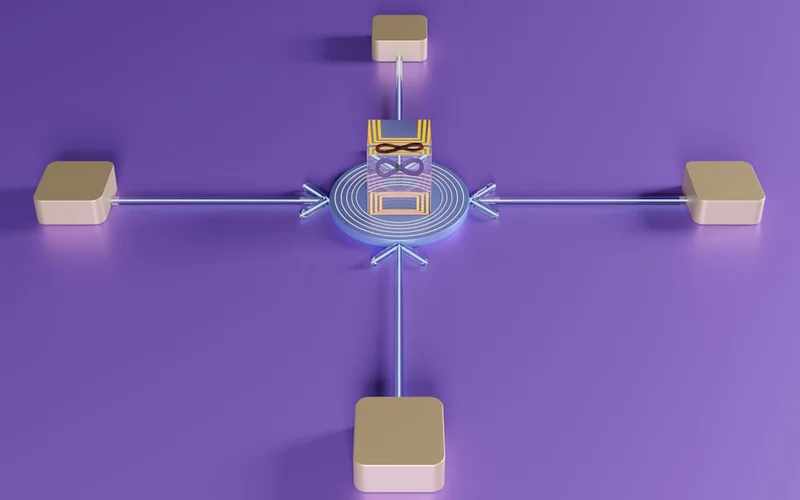
Agents communicate through a shared workspace called a blackboard. Any agent can write to it or read from it. Agents watch for new information and act when something relevant appears.
This pattern shines when sub-problems are interdependent and you don't know in advance which agent will solve what. A medical diagnosis system is a classic example. One agent flags symptoms. Another cross-references drug interactions. A third checks patient history. They all contribute to the same shared picture.
Hybrid Architectures
Most real-world systems mix these patterns. A hierarchical core with some peer-to-peer communication between worker agents. A blackboard for shared state with direct messaging for time-sensitive updates.
Don't get precious about purity. Build what the problem requires.
Our honest opinion: Start simple. A basic hierarchical system with two or three agents will teach you more than a perfectly designed but unbuilt hybrid architecture. Add complexity only when you have a clear reason to.
Designing Your MAS: Key Considerations for Success
Architecture is the skeleton. Design is everything else. Here's what we've learned about making MAS projects actually work.
Define Agent Responsibilities Clearly
Each agent should do one thing well. If you find yourself building an agent that handles research, writes content, and manages publishing, stop. Break it into three agents.
The single responsibility principle applies here just as much as it does in software engineering. Overlapping responsibilities create confusion, redundant work, and bugs that are nearly impossible to trace.
Write a one-sentence job description for each agent before you build it. If you can't do that, the agent's scope is too broad.
Choose the Right Communication Protocol
Not all communication methods are equal. Think about:
- Latency. Does this agent need real-time responses or can it wait?
- Data volume. Are you passing small flags or large payloads?
- Security. Is this communication exposed to external systems?
Standard protocols like FIPA ACL give you a structured foundation. Custom APIs work well for tightly controlled internal systems. Whatever you pick, document it. Future you will be grateful.
Handle Conflict and Cooperation
Agents will disagree. Two agents might both want to update the same resource. A worker agent might receive conflicting instructions from two manager agents in a hybrid system.
Plan for this upfront. Common strategies include priority rules (one agent's output always wins), voting mechanisms, and escalation to a human or higher-level agent. The worst thing you can do is assume agents will naturally cooperate.
Monitoring and Debugging
Debugging a distributed system is hard. Debugging a distributed AI system is harder.
You need: - Centralized logging with timestamps and agent IDs on every action - Visualization tools that show agent states and message flows - Performance metrics per agent, not just for the system as a whole
If you can't see what each agent is doing in real time, you're flying blind.
Scalability and Performance
Design with growth in mind from day one. Can you add a new agent without rewriting your coordination logic? Does your communication layer handle 10x the message volume?
Think about bottlenecks early. A shared blackboard that works for five agents might choke with fifty.
Security
Agents talk to each other constantly. That communication is a potential attack surface. Use authentication between agents, encrypt sensitive payloads, and limit what each agent can access. Least privilege applies here. See also: multi-agent system architecture guide.
Real-World Applications and Getting Started
Still wondering if MAS is worth the investment? Here are the domains where teams are already running these systems today.
Supply Chain Optimization Agents manage inventory levels, coordinate logistics, and communicate with suppliers. When a shipment is delayed, the inventory agent flags it, the logistics agent reroutes, and the supplier agent sends an automated update. No human in the loop unless something breaks the rules. Learn more in GrowthSpike on agentic flow tools.
Smart Grids Energy networks are inherently distributed. Agents balance production and consumption across nodes in real time, responding to demand spikes and outages faster than any centralized system could.
Automated Trading Trading firms run fleets of agents that analyze different market signals, execute trades, and hedge positions simultaneously. Speed and specialization are the whole game here.
Robotics and Swarm Intelligence Drone fleets and warehouse robots coordinate through MAS principles. Each unit has a role. Together they accomplish tasks no single robot could.
Content Generation and SEO This one hits close to home for us. A research agent pulls topics and competitor data. A writing agent drafts content. An editing agent checks quality and tone. A publishing agent handles scheduling and metadata. Each step is faster and more consistent than a single generalist model trying to do it all.
Workflow Automation Any complex business process with multiple steps and decision points is a candidate. Approvals, data processing, notifications, reporting. Agents handle each stage and pass work down the line., -
How to Get Started
Start small. Pick one well-defined problem with two or three clear sub-tasks. Build one agent for each. Get them communicating. See what breaks.
Don't try to build something that manages your entire business on your first attempt.
For frameworks, look at: - JADE (Java Agent DEvelopment Framework): mature, standards-based, good for enterprise use - Mesa: Python-based, great for simulation and experimentation - Custom Python with LangChain or AutoGen: flexible, fast to build, good for LLM-based agents
Pick the tool that matches your team's skills. The best framework is the one you'll actually ship with.
- Multi-agent systems outperform single models on complex tasks by splitting work across specialized, independent agents that each do one thing well.
- Every MAS needs five things: agents, an environment, communication mechanisms, coordination logic, and a clean internal architecture for each agent.
- The three core architectural patterns are hierarchical, federated, and blackboard. Most production systems combine elements of all three.
- Define each agent's single responsibility before you build it. Overlapping roles are the fastest way to create an unmaintainable system.
- Start with a small, well-defined problem and two or three agents. Ship something simple before you add complexity.