
- Where AI content genuinely outperforms human writers in speed, scale, and consistency
- What human writers bring to the table that AI still cannot replicate
- The biggest failure modes of AI-generated content you need to watch for
- How to build an AI-human workflow that produces higher quality than either alone
- How to define 'quality' based on your actual content goals, not a one-size-fits-all standard
- Understanding the Strengths: Where AI Content Truly Shines
- The Human Touch: Unpacking Unique Qualities of Human-Created Content
- Common Pitfalls: Where AI Content Often Falls Short Today
- The Blended Approach: Maximizing Quality with AI-Human Collaboration
- Defining Quality: It Is Not a One-Size-Fits-All Answer
- Mastering Your Content Strategy: The Smart Path Forward
AI-generated content has exploded. Millions of articles, product pages, and social posts are now written by machines. And if you work in marketing or content, you have probably asked yourself: is any of it actually good?
That question sits at the heart of the AI content vs human content quality debate. We have spent a lot of time in the trenches with both, and we have strong opinions. This post breaks down exactly where each approach wins, where each one fails, and how to build a smart strategy that gets you the best of both worlds.
Quick note before we dive in: quality is not a fixed target. What counts as great content for a product description page looks nothing like what counts as great for a thought leadership essay. Keep that in mind as you read.
By the end, you will know how to stop treating this as a battle and start treating it as a choice you make based on your specific goals.
Understanding the Strengths: Where AI Content Truly Shines
Let us be honest about what AI does well. Because it does a lot well.
Speed and scale are the obvious ones. A skilled human writer might produce 1,500 words in two hours. A well-prompted AI model can produce 1,500 words in thirty seconds. Multiply that across hundreds of pages and the math becomes impossible to ignore.
For teams running programmatic SEO campaigns, that speed is a genuine advantage. Think about an e-commerce brand with 10,000 product SKUs. Writing a unique, keyword-targeted description for each one with a human team would take months and cost a fortune. AI can draft all 10,000 in a day.
Consistency is another real strength. Once you dial in your prompts and give the model a clear style guide, it will hold that tone across thousands of pieces without drifting. Human writers get tired, have off days, and naturally vary their voice. AI does not.
AI also handles data-heavy content well. Summarizing earnings reports, turning survey results into readable copy, generating factual FAQ pages from a knowledge base. These are tasks where pattern recognition and synthesis matter more than creativity.
Here are a few use cases where AI is genuinely hard to beat:
- Programmatic SEO pages at high volume
- Product descriptions for large catalogues
- Multilingual content where translation speed matters
- Basic news updates and structured reports
- Email sequence variations for A/B testing
The core point is this: AI's strength is not just speed. It is the ability to process and synthesize information at a scale no human team can match. For the right tasks, that is a serious competitive edge.
The Human Touch: Unpacking Unique Qualities of Human-Created Content
Now let us talk about what AI cannot do. Or at least, what it cannot do well yet.
Human writers bring something that is genuinely hard to replicate: lived experience. When a writer has actually gone through something, that shows up in the prose. The specific detail. The unexpected analogy. The moment of vulnerability that makes a reader think, "yes, that is exactly it."
AI has never felt frustrated, surprised, or proud. It has never lost a client or had a campaign flop at launch. It cannot draw on that. And readers notice, even if they cannot always name what is missing.
Empathy is a big part of this. A skilled human writer can feel the gap between what a reader knows and what they need to know. They can sense when an argument needs slowing down or when a joke will land. AI approximates this by pattern-matching against human text, but approximation is not the same as understanding.
Cultural nuance is another area where humans pull ahead. Sarcasm, irony, regional humor, and subtext are all things that human writers handle naturally. AI often misreads the room.
Then there is original thought. AI recombines existing ideas. It is very good at that. But it does not generate genuinely new frameworks, contrarian takes grounded in real experience, or the kind of insight that comes from sitting with a problem for years. That is a human advantage.
Use cases where human writing is hard to replace:
- Personal essays and brand storytelling
- Investigative journalism and deep research pieces
- Persuasive copy that needs emotional pull
- Brand voice development and tone-of-voice guides
- Thought leadership that requires a genuine point of view
Human content builds trust in a different way. When readers feel a real person behind the words, they are more likely to stick around, share, and buy. Want this done for you? See GrowthSpike AI Content.
Common Pitfalls: Where AI Content Often Falls Short Today
We work with AI content every day. We also see where it breaks. Here is an honest look at the current failure modes.
Hallucination is the biggest one. AI models make things up. They present false statistics, invented quotes, and nonexistent studies with complete confidence. If you publish AI content without fact-checking, you will eventually publish something wrong. That damages credibility in ways that are hard to recover from.
Shallow depth is the second problem. AI processes patterns in text. It does not actually understand the topic it is writing about. This shows up as content that sounds plausible on the surface but does not hold up when a real expert reads it. The sentences are grammatically correct. The logic is superficial. It covers the obvious points without going anywhere interesting.
Sameness is a real issue for SEO too. Because AI models are trained on the same internet, they tend to produce similar outputs. Ask ten different teams to generate an article on the same topic with the same prompt, and you will get ten articles that read like variations of each other. That is a problem in a world where Google is actively looking for original, experience-based content.
Brand voice is hard to maintain at scale. You can prompt your way toward a consistent tone, but AI will drift, especially on edge cases. Getting it to sound like your brand and not like every other brand requires constant human oversight.
Some patterns we see in AI content that readers clock immediately:
- Generic introductions that restate the question without answering it
- Lists that pad word count without adding value
- Transitions that feel mechanical
- Conclusions that summarize without adding anything new
None of this means AI content is bad. It means AI content needs human oversight to be good.
The Blended Approach: Maximizing Quality with AI-Human Collaboration
Here is where we land after running AI content workflows for dozens of clients: the best content comes from pairing AI speed with human judgment.
Think of AI as a very fast first-draft machine. It can take a brief and produce a structured outline and a rough draft in minutes. That is genuinely useful. A human editor then takes that draft and does the work that actually matters: sharpening the argument, adding real examples, cutting the filler, and making sure every fact checks out.
This workflow saves time without sacrificing quality. A writer who used to spend two hours drafting can now spend forty-five minutes refining. The output is often better because the writer is doing the work they are actually good at.
Here are some concrete workflows we use and recommend:
AI for research, human for writing. Feed the AI a topic and ask it to pull together key points, common questions, and competing perspectives. Use that as your research brief. Then have a human write the actual article.
AI for first drafts, human for polish. This works well for mid-funnel content like comparison pages, how-to guides, and FAQ articles. AI gets you 70% of the way there. Human editing gets you to 100%.
AI for variations, human for selection. Need ten subject line options or five different CTAs? AI can generate those fast. A human picks the one that fits the brand and the audience.
AI for SEO structure, human for voice. Let AI map out keyword placement, heading structure, and meta descriptions. Let the human write the actual prose.
This is not about AI replacing writers. It is about writers doing less of the tedious work and more of the high-value work. That is a better deal for everyone.
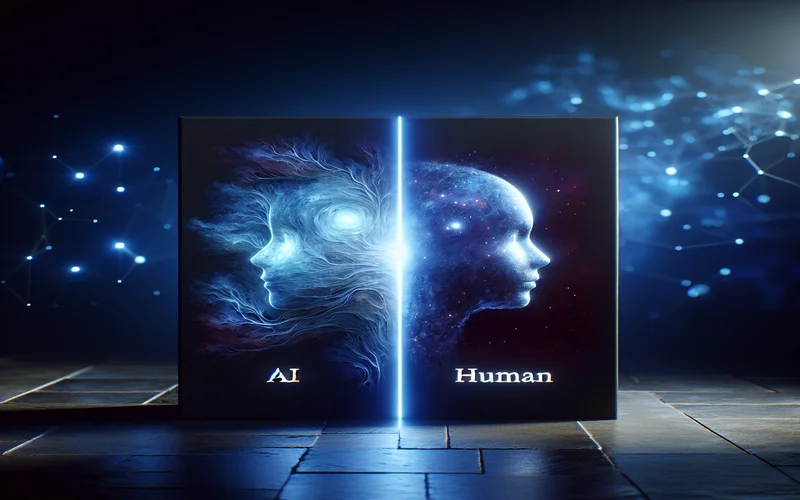
Defining Quality: It Is Not a One-Size-Fits-All Answer
Before you decide whether AI or human content is better for your business, you need to get clear on what quality actually means for your specific situation.
Quality is not a universal standard. It is a function of purpose and audience.
For a programmatic SEO page, quality might mean: accurate information, proper keyword placement, readable structure, and consistent formatting across thousands of pages. AI can hit all of those marks. A human team struggling through their five hundredth product description of the week probably cannot match that consistency. Learn more in AI content strategy for SEO agencies.
For a thought leadership piece, quality means something completely different. It means a clear, original point of view. It means real examples from real experience. It means the kind of argument that makes someone stop and rethink something they believed. AI cannot produce that reliably.
So when someone asks us, "is AI content good enough?", our answer is always: good enough for what?
Here is a simple framework for thinking about it:
| Content Type | Priority | Better Fit | |, -|, -|, -| | Product descriptions (volume) | Consistency, speed | AI | | Programmatic SEO pages | Scale, keyword accuracy | AI | | How-to guides | Accuracy, clarity | AI + Human | | Brand storytelling | Voice, emotion | Human | | Thought leadership | Originality, depth | Human | | Investigative content | Research, nuance | Human |
The teams we see getting the best results are the ones who have mapped out their content types and made a deliberate choice about where AI fits and where it does not. They are not using AI for everything. They are not avoiding it either. They are being strategic. See also: AI content vs human content quality comparison.
That is the move.
Mastering Your Content Strategy: The Smart Path Forward
So where does this leave us?
AI is not better than human writers. Human writers are not better than AI. That framing is the wrong one entirely.
The real question is: what does your content need to do, and what is the right tool for that job?
AI is a genuine game-changer for teams that need to produce content at scale without proportionally scaling their budget. It is fast, consistent, and good at structured tasks. Those are real advantages that smart content teams are already using.
Human writers remain the right choice for content that needs to connect, persuade, or say something genuinely new. They bring judgment, experience, and creativity that AI cannot fake convincingly yet.
The teams winning at content right now are not picking a side. They are building hybrid workflows where AI handles the volume work and humans handle the work that actually requires a brain and a point of view.
Our recommendation is simple: audit your content output. Sort it by type and purpose. Identify where speed and consistency matter most. Start using AI there. Keep humans on the content that builds your brand and earns real trust.
Content creation is changing fast. The teams that adapt without losing what makes their content worth reading will be the ones that come out ahead. That means being honest about what AI can and cannot do, and making deliberate choices rather than defaulting to one tool for everything.
We are still in early days. The tools will keep improving. But the fundamentals of good content, clarity, honesty, genuine usefulness, those are not going anywhere.
- AI content is best for high-volume, structured tasks like product descriptions and programmatic SEO pages where speed and consistency matter most.
- Human writers still lead on originality, emotional depth, and cultural nuance. For brand storytelling and thought leadership, there is no real substitute.
- AI hallucination is a genuine risk. Every piece of AI-generated content that makes factual claims needs human fact-checking before it goes live.
- The highest-quality content workflows combine AI for drafting and structure with human editing for accuracy, voice, and real insight.
- Quality is defined by purpose. Decide what your content needs to achieve before choosing AI, human, or a hybrid approach.